PHP, Next.js, Rails and .NET flaws: autumn 2026
Two runtime bugs reached CISA's exploited list in October, and Next.js, React, Rails, Laravel and ASP.NET Core all shipped critical fixes. What to patch first.

Mayank Tripathi · Founder, CyberSpec
5 min read
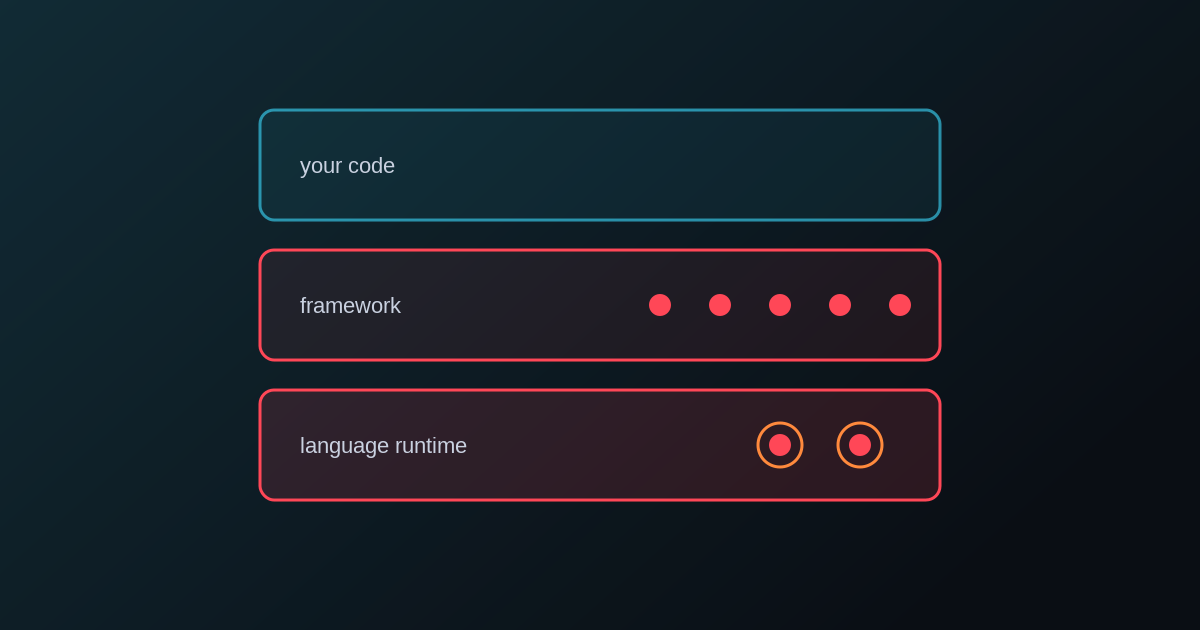
Most website owners think of security bugs as something in their own code: a form that forgot to escape input, an admin page left open. This autumn the serious framework and language vulnerabilities were somewhere else. Between September and November 2026, PHP, Node.js, React, Next.js, Rails, Laravel and ASP.NET Core all shipped fixes their maintainers rated critical. Two of them reached CISA's Known Exploited Vulnerabilities catalogue within a week of disclosure. None of it is code a site owner wrote, and all of it runs on their site.
The seven fixes, in one table
| Fixed | Project | CVE | Score (who scored it) | In KEV |
|---|---|---|---|---|
| 21 Oct | PHP | CVE-2026-109618, -109619 | 9.2 v4 (PHP) | 26 Oct |
| 21 Oct | Brotli in Node.js and .NET | CVE-2026-111497 | 9.2 v4 (Google) | 27 Oct |
| 14 Oct | React Server Components / Next.js | CVE-2026-126187 | 9.5 v4 (GitHub) | No |
| 14 Oct | Next.js Image Optimization | GHSA-2464-fhr4-w9xw | 9.5 v4 (Vercel) | No |
| 4 Nov | Rails Active Storage | CVE-2026-122006 | 9.8 v3 (Rails) | No |
| 13 Oct | ASP.NET Core Kestrel | CVE-2026-88092 | 9.4 v3.1 (Microsoft) | No |
| 19 Oct | Laravel TokenGuard | CVE-2026-114509 | 9.2 v4 (Laravel) | No |
Scores mix CVSS v3 and v4 and come from the vendor, so they aren't directly comparable. KEV dates are from CISA's catalogue feed. As we've argued before, a CVSS score alone isn't a priority order, so patch the two KEV entries first.
PHP: two bugs that run before your code does
The PHP project fixed two memory-safety flaws on 21 October in 8.5.12, 8.4.27, 8.3.36 and 8.2.35 (PHP announcement).
CVE-2026-109618 lets an attacker force an out-of-memory error with a crafted multipart upload, which leaves request memory in a bad state that cleanup then trusts. On Apache with mod_php the advisory shows unauthenticated code execution at default limits, before any application code runs. CVE-2026-109619 is a use-after-free where one request's state leaks into the next. One confirmed path is session upload progress, which is on by default.
CISA issued an alert the same day
and added both to KEV on 26 October. PHP calls every workaround partial,
and that includes setting session.upload_progress.enabled=0. PHP 8.1 and older get no
official release, only source backports.
A second batch landed on 19 November. The one to check is
CVE-2026-129289,
FastCGI request smuggling in PHP-FPM. It only applies if you turned on
backend connection reuse (nginx fastcgi_keep_conn on, Apache
enablereuse=on), which isn't the default.
Node.js and .NET: a bug in a library you didn't pick
CVE-2026-111497 is an
out-of-bounds write in Google's Brotli decompressor. Node.js and .NET both
bundle it, so you inherit it whatever your package.json says.
Node.js fixed it
in 22.23.4, 24.22.1 and 26.12.1. .NET fixed it
in 8.0.33, 9.0.22 and 10.0.14. It entered KEV on 27 October.
You're exposed if your app decompresses Brotli data an attacker sent you,
for example through node:zlib in Node. ASP.NET Core doesn't decompress
Brotli by default. The same Node release also fixed two TLS hostname
verification bypasses, so upgrading is worth doing either way.
React and Next.js: three critical fixes in five weeks
On 14 October React fixed CVE-2026-126187,
unauthenticated code execution in the React Server Components packages.
React says it hits only rare cases. In Next.js that means the App Router
with Cache Components and a use cache function that returns multiple
typed arrays. Next.js's advisory
tells you to upgrade even if you don't think you match.
The same release fixed an Image Optimization flaw: a memory bug in an upstream SVG library, reachable over the network on glibc-based Linux. It affects every version from 10.0.0 up to 15.5.27, and 16.x up to 16.4.0. The fixed versions are 15.5.28 and 16.4.1. In September the next/og image route had a similar problem.
Next.js reused the upstream library's CVE number for these, so the NVD score you see (7.8, local) describes the library, not the network-reachable bug in Next.js. Read the GitHub advisory, not the NVD page.
Rails: an upload that writes files
CVE-2026-122006
hits Active Storage apps that let untrusted users upload images. If you use
mini_magick (the default for apps on load_defaults 6.1 or earlier), and
your ImageMagick policy doesn't block the dangerous coders, an upload can
write files on the server. Debian and Ubuntu packages don't block them. On
the Disk service an upload can also read files, including secret_key_base,
which leads on to code execution. Fixed in 8.0.5.2 and 8.1.4.1. If you were on
the Disk service, rotate your secrets after upgrading.
The GitHub advisory still shows CVE-2026-126082. That ID was rejected as a duplicate on 12 November, so search for CVE-2026-122006.
ASP.NET Core request smuggling and a Laravel login bypass
CVE-2026-88092 is request smuggling in Kestrel: when a connection aborts, leftover body bytes can be read as a second request. That's how an attacker slips a request past a proxy's checks. Fixed in ASP.NET Core 8.0.32, 9.0.21 and 10.0.13. Rebuild self-contained apps, because they carry their own copy of the runtime.
CVE-2026-114509 lets a crafted non-string token log in as an existing user through Laravel's built-in TokenGuard on MySQL or MariaDB. That's account takeover on any API route behind the guard. Fixed in 12.68.0 and 13.29.0.
What we left out
Django, Express, Angular, Nuxt, Go, CPython and OpenJDK all shipped security releases in the window. None reached critical with a realistic network path. Spring Security published CVE-2026-59273 on 19 November, rated critical but with a narrow precondition. If you run Spring, read it today.
Finding out which of these you run
For a small team, knowing the version is harder than patching it. The agency that built the site picked the framework, the hosting image picked the PHP version, and nobody wrote either down. You can't patch a version you don't know you're on.
On sites you've verified, CyberSpec detects the framework and CMS from what the server returns, and when the version is exposed it flags outdated and end-of-life releases. It doesn't patch anything. What you get is a finding such as "the site the agency handed over runs Next.js 15.4", which you can check against the table above. See the scanning product for what a scan covers.
Autumn 2026 patch checklist
- Write down the language runtime and framework version for every site and API, including staging and anything an agency or contractor runs.
- PHP: 8.2.36, 8.3.37, 8.4.28 or 8.5.13 (the 19 November releases include the October fixes). Move off 8.1 and older.
- Node.js 22.23.4, 24.22.1 or 26.12.1 or later. .NET runtime and ASP.NET Core to the October servicing release or later, then rebuild self-contained apps.
- Next.js 15.5.28 or 16.4.1 or later, and React's server packages to the matching patched release.
- Rails Active Storage 8.0.5.2 or 8.1.4.1, and rotate secrets on the Disk service.
- Laravel 12.68.0 or 13.29.0 if you use TokenGuard.
- For Cyber Essentials, these all count: fixes rated critical or high go on within 14 days, under the NCSC's patching requirement.
- Web Application Security
- CISA KEV
- Patch Management
- PHP
- Next.js
Related
- How CyberSpec scanning works : scheduled scans, ownership verification, live progress.
- SOC 2, ISO 27001 and PCI DSS coverage : what maps to which control family, and what doesn't.
- CVE-2026-0322 & CVE-2026-104286: edge patches : Patch status for CVE-2026-0322 (PAN-OS), CVE-2026-104286 (FortiMail) and five more edge flaws CISA listed as exploited in October 2026, with the fixes.
- Outdated or end of life? How to tell the two : "Out of date" covers two different problems: a missed patch and a release line nobody fixes any more. They fail differently, and they are fixed differently.
- AI cyber attacks and the shrinking patch window : AI is helping attackers turn fresh patches into working exploits faster. What the 2026 data shows, what it doesn't, and what a small UK firm should change.