Authenticated vs unauthenticated scanning
One scan tells you what an outsider can reach. The other tells you what is installed. Swapping the two is how a finding list stops matching reality.

Mayank Tripathi · Founder, CyberSpec
3 min read
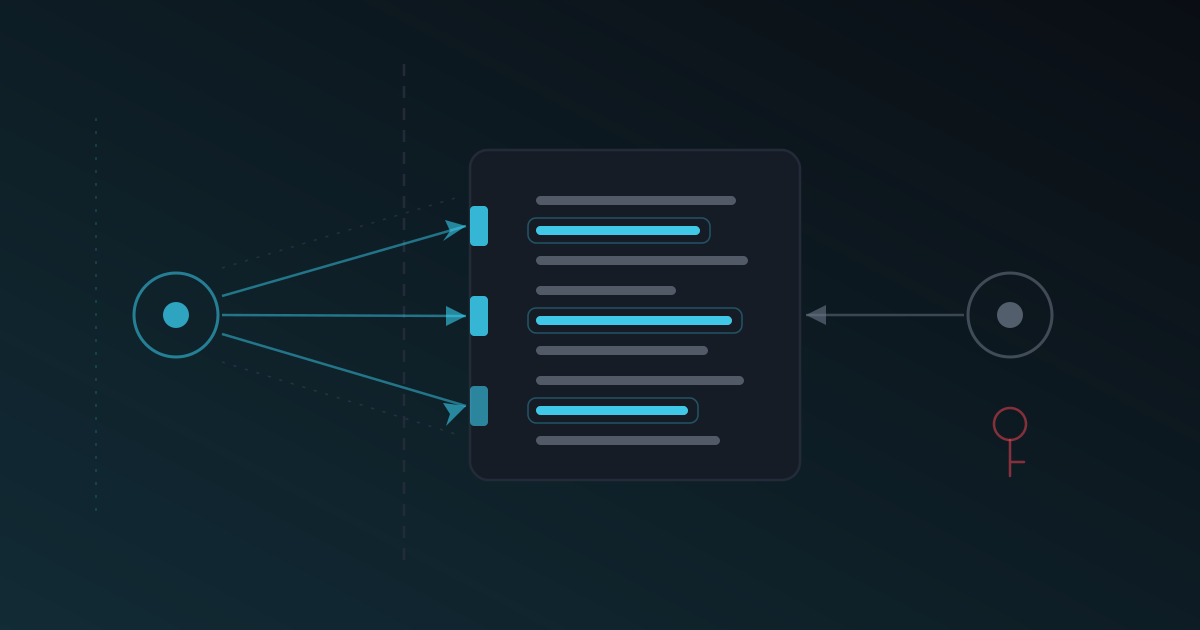
Two scanners point at the same server and return different findings. Neither is broken. An unauthenticated scan sees what the host tells a stranger; an authenticated one reads the package list. They are measuring different things, and most arguments about scanner accuracy are really arguments about which question was asked.
What an unauthenticated scan actually knows
It connects to ports and reads what comes back. Service detection infers a product and version from the banner, the TLS certificate, response headers and protocol quirks, and that inference is then matched against CVE data.
That gives you two things nothing else does. First, ground truth on exposure: if the scanner reached port 5432 from the internet, so can anyone, and no firewall diagram claiming otherwise survives that. Second, the attacker's own view — what an unauthenticated stranger can enumerate before they have any access at all.
What it cannot know is everything the host does not announce. A vulnerable library used by an application behind a reverse proxy, a package installed but not listening, a configuration weakness with no wire signature — invisible.
The backporting problem
The most common false positive in unauthenticated scanning has one cause. Distribution maintainers backport security fixes into the version they ship rather than bumping the version number. A Debian or RHEL package will report itself as an old release long after the specific vulnerability was patched in it. The banner is honest, the CVE match is arithmetically correct, and the finding is still wrong.
The mirror error runs the other way: a banner that has been suppressed or rewritten produces no finding for a service that is genuinely vulnerable. Absence of a banner is absence of evidence.
Both are treatable. Confirm a suspected backport against the distribution's security tracker before scheduling emergency work, and treat a scanner's version inference as a lead rather than a verdict — which is the same discipline behind why a CVSS score alone is not a priority order.
What authenticated scanning buys and costs
Log in, and the guessing stops. An authenticated scan reads the installed package inventory with exact versions, sees software that is not listening on anything, and can check configuration — password policy, service settings, file permissions — that no external probe reaches.
The cost is access. You need credentials on every scanned host, distributed and rotated, and the account that can read all of that is a high-value target by construction. A scanner with domain-wide credentials is infrastructure that needs the same protection as your identity provider, because compromising it returns both a map and a key.
| Unauthenticated | Authenticated | |
|---|---|---|
| Answers | What can a stranger reach? | What is installed here? |
| Version accuracy | Inferred from banners | Read from the package manager |
| Sees non-listening software | No | Yes |
| Sees configuration weaknesses | Rarely | Yes |
| Proves exposure | Yes | No |
| Needs credentials on the host | No | Yes, on every host |
| Typical false positive | Backported fix read as vulnerable | Few, but scope is what you gave it |
Note the row that gets forgotten: an authenticated scan does not prove reachability. It will report a vulnerable package on a host with no route from the internet at exactly the same severity as one on your public gateway. That is why an internal-only programme tends to produce a large undifferentiated backlog — everything is a finding and nothing is a priority.
Use them for the jobs they do
Run unauthenticated scans from outside, continuously, against everything that resolves publicly. That is the exposure question, it changes without anyone deploying, and it is the only view that matches what an attacker starts with.
Run authenticated scans on the estate you control, on a slower cadence, to get accurate inventory and to settle the version questions the external scan can only guess at. Where the two disagree about a version, the authenticated answer wins. Where they disagree about whether something is reachable, the unauthenticated one does.
CyberSpec runs external, unauthenticated scans — nmap with service detection,
correlated to CVEs through the vulners NSE script, producing findings with
CVSS scores and vectors, CVE and CWE references, and host:port detail. No
credentials on your hosts, because none are needed for the question it answers.
Ownership of each asset is verified by DNS TXT record or a well-known file
before anything is scanned. See
network scanning and
vulnerability management.
If you only have budget or appetite for one, start outside. The findings an external scan misses are ones an attacker also has to work for; the ones it catches are already sitting in the open.
- Vulnerability Management
- Network Scanning
- External Scanning
- Patch Management
Related
- How CyberSpec scanning works — scheduled scans, ownership verification, live progress.
- SOC 2, ISO 27001 and PCI DSS coverage — what maps to which control family, and what doesn't.
- PCI DSS 11.3.2: what ASV scanning requires — External scans every three months, from an Approved Scanning Vendor, with a passing result. Here is what each of those three constraints costs you.
- What counts as your external attack surface — It is never the list in your asset inventory. It is whatever answers on a public address today, including the things nobody remembers standing up.
- Ports that should never face the internet — RDP, database ports and container control planes end up publicly reachable the same handful of ways — almost never by decision.